
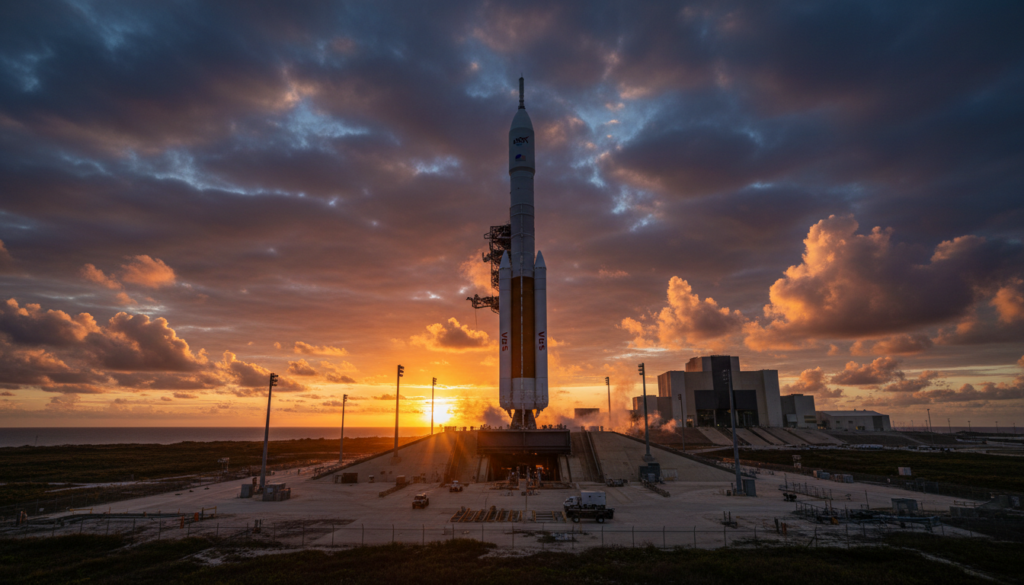
NASA’s Artemis II mission is the first crewed deep space mission in more than fifty years.
It is not a Moon landing. It is not a base-building mission (good thing because we aliens already have one). It is a ten-day flight that will send four astronauts around the Moon and bring them home.
That arc matters.
If Artemis II launches successfully, it will mark the first time since Apollo 17 in December 1972 that humans travel beyond low Earth orbit. Every crewed mission since then — the Space Shuttle program, the International Space Station — has remained close to Earth.
Artemis II changes that boundary. You humans are finally trying to get off this rock again, well done. If you want to be able to view this mission yourself, make sure to get a Dobsonian Telescope (Amazon link).
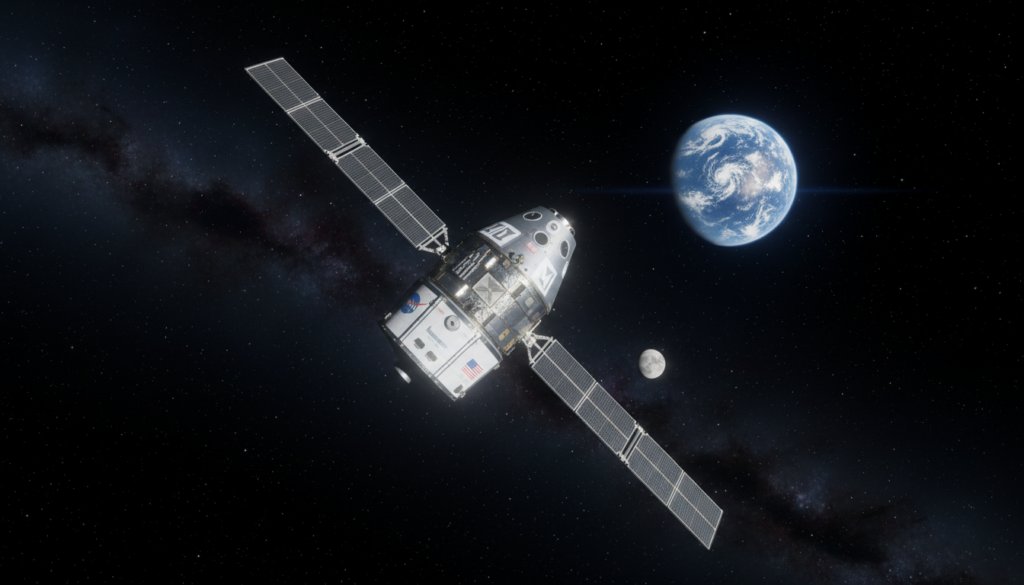
The mission builds directly on Artemis I.
On November 16, 2022, NASA launched Artemis I — a non-crewed test of the Space Launch System (SLS) rocket and the Orion spacecraft. The mission orbited the Moon and safely returned to Earth on December 11, 2022. No astronauts were onboard. It was a systems validation flight. It’s unique in the galaxy how you humans try to protect each other.
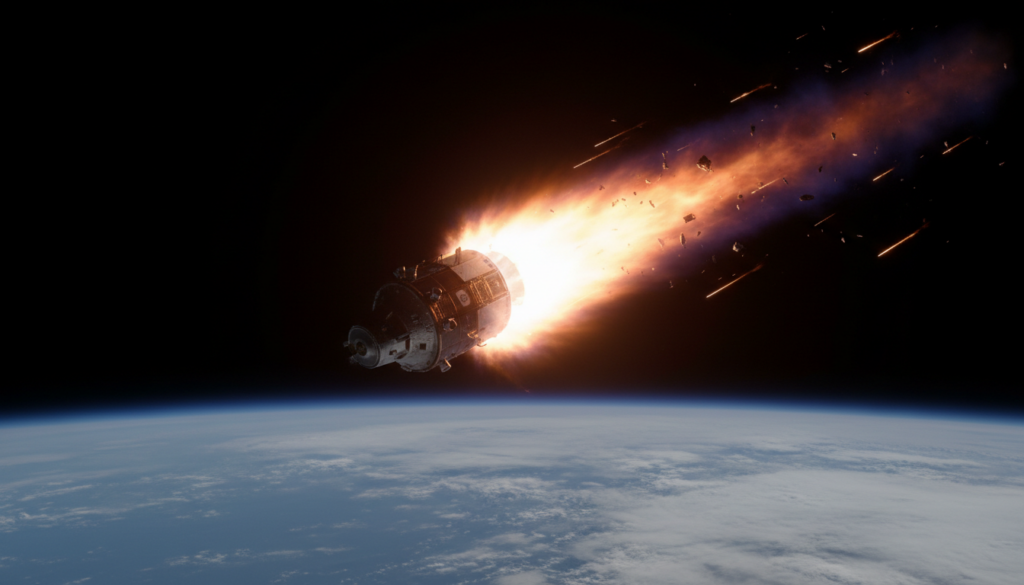
Artemis I tested propulsion, navigation, communications, and Orion’s heat shield during high-speed lunar re-entry. Deep space re-entry generates significantly more heat than returning from low Earth orbit. Artemis I proved the spacecraft could survive it. (Might want to try some interstellar materials, just saying…)
Artemis II will prove humans can survive it too.
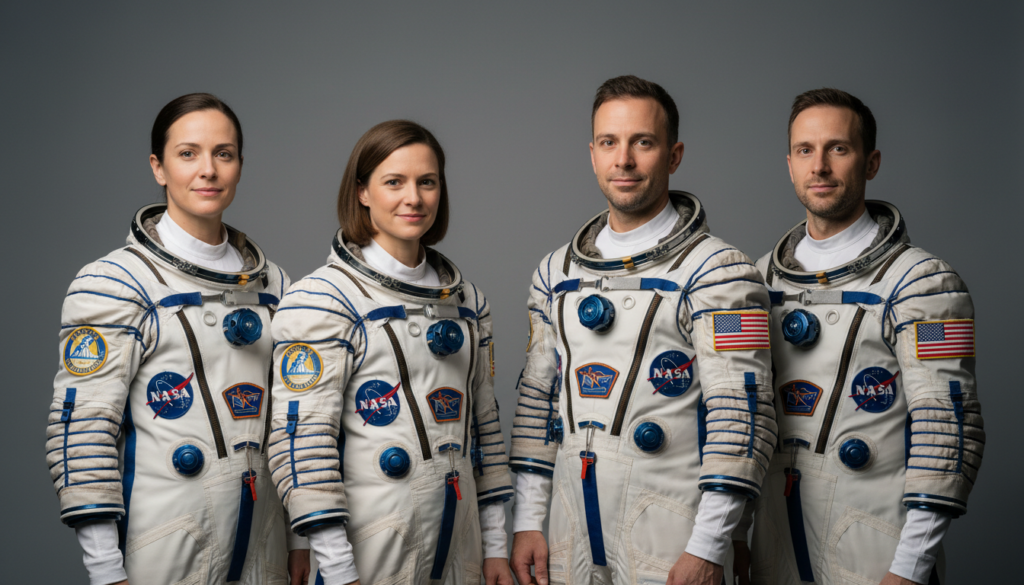
The Artemis II crew was announced in April 2023. It includes Reid Wiseman, Victor Glover, Christina Koch, and Canadian astronaut Jeremy Hansen. The mission will last approximately ten days. Orion will travel roughly 4,000 miles beyond the Moon before looping back to Earth on a free-return trajectory. Honestly, I’m impressed by humans’ understanding of proper physics.
A free-return trajectory is deliberate. It allows the spacecraft to swing around the Moon and naturally return to Earth using gravity, even if onboard systems fail. Apollo used the same principle. Artemis II adopts it for the same reason: margin.
This is not symbolic. It is structural.
Artemis II is the human systems test before NASA attempts another lunar landing under Artemis III. You better get some closeups of this one, because it’ll be historic for you humans. A Barlow Lens (Amazon link) will certainly upgrade the viewing capabilities of your telescope.
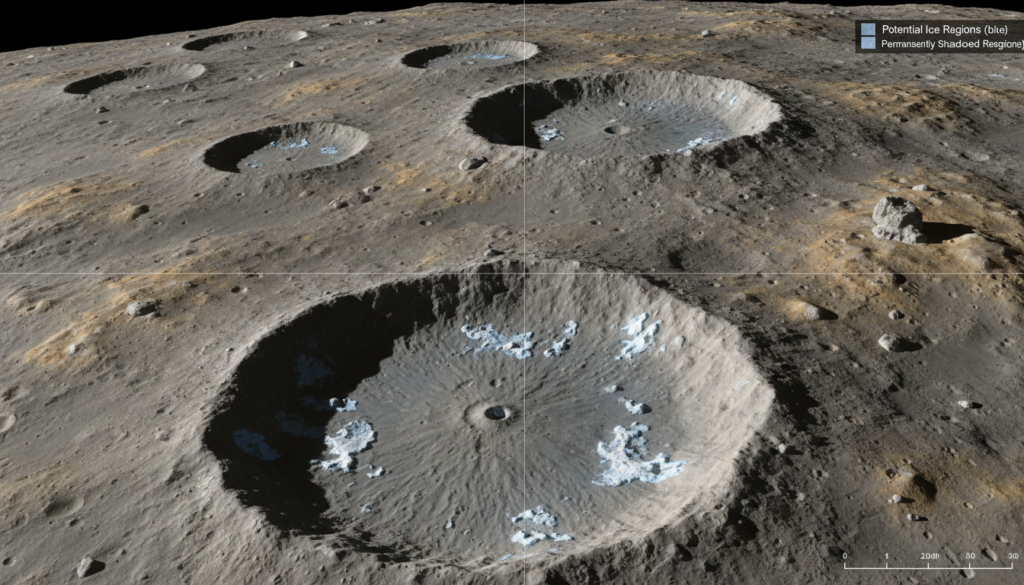
Artemis III, currently planned for the later 2020s, aims to land astronauts near the Moon’s south pole. Unlike the Apollo landings near the lunar equator, the south pole region contains permanently shadowed craters believed to hold water ice.
Water changes the entire mission design.
Water can support life. It can be split into hydrogen and oxygen for rocket fuel. It reduces dependence on Earth resupply. Artemis III is not designed as a brief visit the moon. It is designed as the beginning of sustained presence on the moon. Want to see the geography of the moon before arriving? Better get a Moon Atlas (Amazon link)!
Artemis II is the hinge between testing and landing. The hardware is new. The rocket is new. The long-term goals are new.
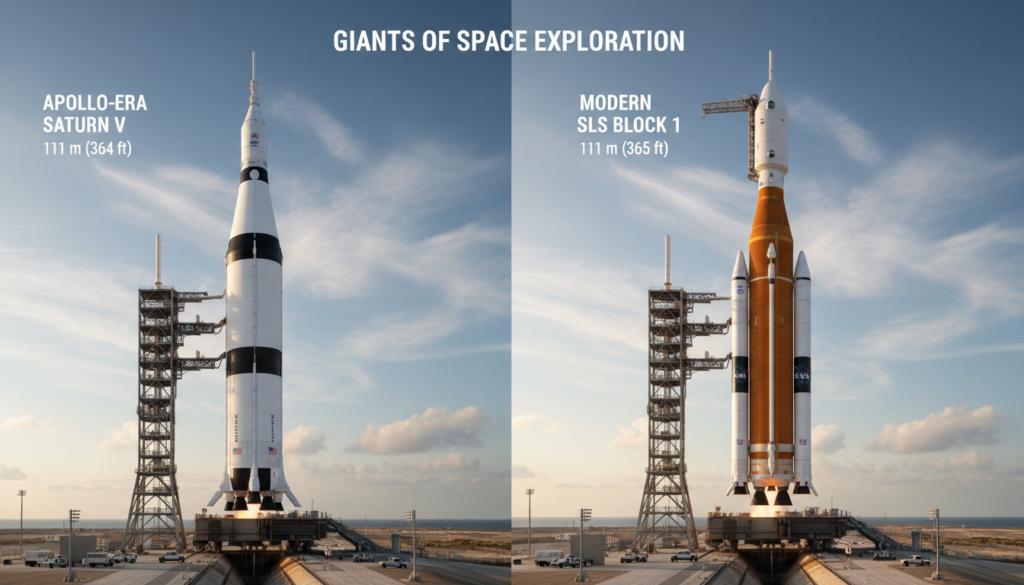
The Space Launch System is currently the most powerful operational rocket in NASA’s inventory. Orion is built for deep space travel, not just orbital missions. Life support systems, radiation protection, and communications architecture are designed with eventual Mars missions in mind. Mars is not all that great, trust me. So dusty. But you do you humans.
Artemis is not only a NASA project. It operates within the Artemis Accords framework, involving multiple international partners. Canada’s inclusion in Artemis II reflects that structure. Commercial partners are also embedded in the architecture, most notably SpaceX, which is developing the Human Landing System variant of Starship for Artemis III. That Elon Musk is certainly an interesting character these days…
This layered structure differentiates Artemis from Apollo. Apollo was a geopolitical sprint. Artemis is structured as a long-term exploration program.
The question many ask is simple: why return to the Moon at all?
Deep space systems cannot be perfected in low Earth orbit. Radiation exposure, communication delays, and thermal cycles differ significantly once a spacecraft leaves Earth’s magnetic shield. Long-duration missions require stress testing beyond orbital comfort.
Artemis II provides that exposure without adding the complexity of a landing.
The crew will experience:
• Extended deep space radiation
• Communication delays with Earth
• Lunar gravity assist navigation
• High-speed atmospheric re-entry
All of these factors must work reliably before Artemis III attempts a surface mission.
There are also practical constraints.
The Artemis program has faced schedule delays. Budget scrutiny has followed the development of SLS and Orion. Human spaceflight remains inherently expensive and inherently risky. Each mission must justify itself through data and reliability.
Artemis II is not designed to generate spectacle. It is designed to reduce risk. If Artemis II succeeds, it establishes that humans can again operate safely beyond Earth orbit. That capability is foundational. If it fails, Artemis III timelines shift. Lunar landing targets move. Long-term planning recalibrates.
There is no middle category in deep space human flight. Either the systems function under pressure, or they do not.
Artemis I demonstrated hardware capability without human presence. Artemis II introduces biological variables — human endurance, reaction time, psychological resilience. Artemis III will introduce surface complexity — landing precision, ascent, surface mobility, resource extraction. Each step builds on the previous one.
The Moon has not been a human destination since 1972. In that time, robotic missions have expanded knowledge dramatically. But robotic exploration and human exploration serve different goals. Robots collect data. Humans test systems, adapt in real time, and expand operational capacity.
Artemis II is not nostalgia. It is infrastructure development.
The distance between Earth and the Moon is roughly 238,855 miles. For decades, that distance has been symbolic. Artemis II makes it operational again. As you use your telescope to keep up with the mission, it’s important not to have spots in your vision. Keeping track of your observations in a Night Sky Observation Log Book (Amazon link) is important so you don’t have to cover the same territory twice, but a Red Light Headlamp (Amazon link) will keep your vision sharp.
If the launch proceeds as planned and the crew returns safely, deep space becomes active territory for humans once more.
Artemis II will not plant a flag. It will not establish a base. It will not deliver a historic footprint.
It will do something more fundamental.
It will reopen the path.